
Are Survival Food Buckets Worth It?
A serious take.

At a time when Americans are struggling to buy basic groceries, Costco is selling a year’s worth of emergency food buckets for about $3,000.
It’s designed to feed one person.
If you could actually live on survival food for a year, maybe it wouldn’t be a bad deal. Can you, though? Several companies sell emergency food kits. There’s Readywise, 4Patriots, Ready Hour, Augason Farms, Mountain House, Backpacker’s Pantry (Vegetarian), Good-to-Go (Vegan), and Valley Food Storage. We could go on, but those are the big ones. The cost runs anywhere from $100 to $200 per bucket these days. One bucket feeds one person for a couple of weeks.
Various prepper channels push these buckets hard. Others trash the idea of food buckets in general, even if they have deals to promote certain brands. It sounds appealing to have a year’s worth of food ready to go that lasts for decades. They cook up quick. All you need is water and some camping cookware (and heat).
Every now and then, you hear someone bragging about stocking an entire basement or bunker with these things, enough to last decades.
Are they worth it?
As an article in The New York Times explains, emergency meal kits really come in two main categories. You have the “shelter in place” food buckets that require boiling water (or near boiling) to cook. They tend to cost less than the other category, freeze-dried meals made for backpackers and bugout bags. The freeze-dried meals don’t need boiling water. They’re easier to carry, but more expensive.
I’ve tried both.
An article in Food & Wine does a thorough job unpacking the general idea of relying on food buckets to supply all the calories and nutrients you’d need to stay alive during an extended emergency. They interviewed a range of nutritionists and dietitians for their take. All of them said these types of kits aren’t enough.
They come up short on protein, vitamins, and minerals. Sometimes, they even come up short on calories. You’d have to eat double or triple the recommended servings to get enough, despite the claims. That becomes a problem when you look at the sodium and sugar content. A single serving often contains 30 percent of your daily limit. They provide a bare minimum of basic sustenance, and that’s it. If you tried to eat enough to feel full, you’d wind up doubling or tripling your sodium intake.
Think of food buckets this way:
They’re designed to keep you from going hungry during an emergency, and they’re designed to last for 20 or 30 years so you can buy them once, store them somewhere cool and dry, and then never think about them again.
Until SHTF...
Honestly, this one article does the best job reviewing the strengths and weaknesses of food buckets I’ve seen on the internet. They even tackle the key premise behind these buckets, that they can last for 25 years or longer.
Turns out, it’s only sorta true.
Take a look:
“The vast majority of the vitamins and micronutrients will have degraded after five years,” even under the most advanced storage conditions, despite extensive research conducted by groups such as NASA in an attempt to further extend food shelf life... Nevertheless, the food is still considered safe to eat within its 25-year shelf life, he confirms.
So, food buckets won’t kill you, but they definitely won’t keep you alive during an extended emergency or a collapse. They don’t start with very many vitamins and minerals, and it all goes downhill from there.
According to The New York Times, freeze-dried food does considerably better when it comes to preserving nutrients. You could conceivably last for a while on that. It keeps astronauts alive for long periods of time. Of course, a true year’s supply of healthy freeze-dried food is going to cost more than $3,000.
If you’ve ever bought one of these buckets out of curiosity, then you’ve probably observed as much on your own. It’s still nice to get some confirmation from experts. Apparently, these buckets are especially bad for anyone with chronic conditions like diabetes, heart disease, and high blood pressure. They’re also potentially dangerous to anyone with food allergies. That’s a lot of Americans...
As for the taste, it’s not terrible. It’s even pretty good.
Verdict:
It’s probably worth keeping a couple of food buckets to feed yourself or your family during an emergency. It’s also probably worth stashing a handful of freeze-dried meals in a bugout bag so you don’t go hungry if you have to leave home. The experts say that eating half of your normal calories can keep you going.
If you want to make healthier and potentially cheaper emergency meals, then you can. It’s not that complicated. You can buy dehydrated and freeze-dried foods like beans, lentils, rice, and vegetables. You can even buy powdered kale. Throw in some shelf-stable seasoning. (Most spices last for years, and they’re safe even after they start to lose their flavor.) Drop them into MRE-sized pouches made out of Mylar. Add oxygen absorbers. Seal them up with a flat iron. They’ll last a long time. If you’re worried about them going bad, replace them every few years. Eat them.
Freeze-dried and dehydrated foods cook up fast. It’s still a good idea to boil dehydrated beans to deactivate the lectins. If you don’t have that option, dehydrated foods will usually rehydrate with regular water, unheated.
Oats, beans, lentils, rice, and pasta last for extremely long periods of time. Apparently, pasta found in ancient pyramids still tastes fine.
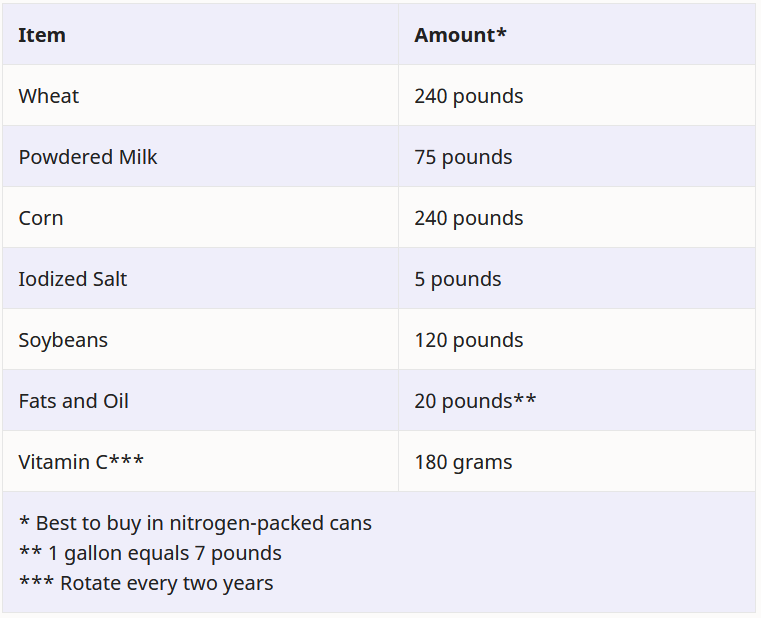
You can find food storage calculators online that tell you exactly how much food you’ll need to get all of your basic calories and nutrients. When I’m storing food, I use several of them and cross-check. Here’s a good one. According to food safety specialists at UGA, the average adult needs this much food:
Space adds another constraint here. I’ve done the math. If you maxed out the shelving in a standard bedroom, you could probably store enough food for a family of four for a few years, maybe even a little more. Ideally, you’d want a basement to keep the climate controlled and maximize the shelf life.
Having the food is one thing. Protecting it?
That’s another.
Of course, most of us probably just need to store enough to last a few months. Most serious preppers shoot for a year. Beyond that, you run into budget problems. You run into space problems. You run into security problems. You want emergency food to add security. You don’t want it to become a liability.
Or a burden...
If you can afford to store extra food right now, it’s worth doing that to help any friends, relatives, or neighbors who can’t.
If you’re on a tight budget, don’t stress too much about it. Plenty of people have spent hundreds or even thousands of dollars on stored food, and it won’t help them as much as they think, if they don’t have other preparations in place.
So, that’s the deal on food buckets. They’re part of a prepper pantry, but they’re not going to keep anyone alive during a true collapse. Millionaires and billionaires who fill their bunkers with these things are going to have a rough time.
Very rough.