
How Bad Will Things Get Now?
You deserve to know.

“This is only the barest beginning.”
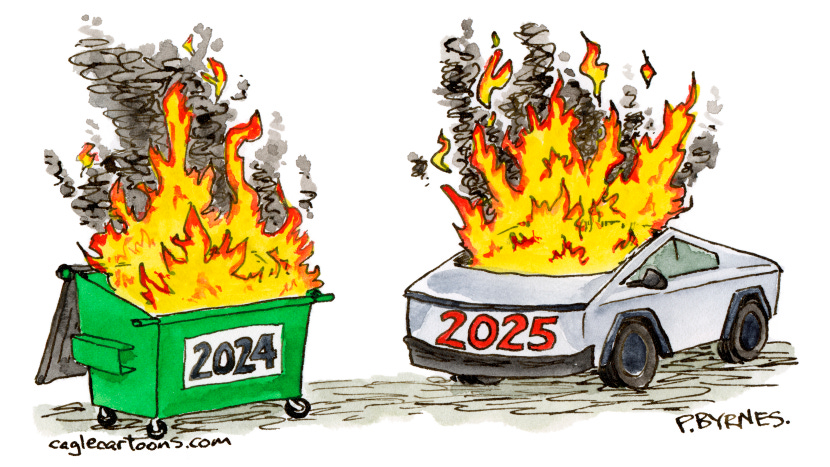
That’s Peter Kalmus, one of the most honest climate scientists out there, talking about the wildfires in L.A. Of course, he’s not just talking about the wildfires. He’s talking about the hurricanes, the storms, the heat domes, the blizzard hitting the gulf coast, and the smoke that covered half the U.S. back in 2023. The last 18 months have brought us a nearly endless string of historic disasters. Let’s throw in the H5N1 bird flu now mutating faster than expected. Kalmus goes on: “These kinds of disasters will get much, much worse.” A 2023 paper by James Hansen, considered a father of climate science, references storms flinging boulders to the tops of mountains in our future. Replace boulders with cybertrucks and debris from the nearest data center, and you’ve got a snapshot of what lies ahead for us.
It’s going to get flying cybertrucks on fire bad.
Now that the ultimate fascist climate denier has taken the wheel, a lot of worried minds out there are wondering just how bad things will get. They’re still trying to wrap their heads around the next year, let alone the next decade. There’s no easy way to put this, but we’re going to spend the rest of this crucial decade under a regime that fully intends to end humanity for profit—and too many Americans are right there with them. Maybe they’re scared to think about it.
I’m not.
Someone needs to spell things out in clear, unambiguous terms. They need to take Kalmus as a starting point and really dig in.
You deserve to know…
For one big reason.
You deserve to know because our time on this planet is precious, and nobody should waste it lying awake at night wondering how bad things are going to get or when. They deserve to know so they can prepare, however they see fit. Honestly, it gives me a little peace of mind to sift through the evidence and develop a full portrait of what’s likely to happen now. It lets me focus on what matters.
Let’s start with something simple:
Hurricane Helene.
The media moved on quickly from that, but it left a permanent scar on U.S. supply chains. As a story in The Grist made clear, the deadliest hurricane since Katrina “dismantled farming operations that serve as linchpins for the nation’s food supply chain.” The winds alone “destroyed hundreds of poultry houses across Georgia and North Carolina, which account for more than 25 percent of the machinery used to produce most of the country’s chicken meat.” The flood waters tore apart North Carolina’s agriculture network, destroying vast amounts of feed and fertilizer, driving up costs for the entire region.
Total crop insurance payouts could reach $7 billion.
Oh, it doesn’t stop there.
Helene knocked out a major manufacturing hub that produces 60 percent of the nation’s IV fluids. By late October 2024, more than 86 percent of healthcare providers were dealing with shortages. Nearly 20 percent of those providers were having to postpone surgeries. The shortage has dragged into this year, although things seem to be getting a little better. This particular disaster might remind you of the Pfizer plant that got knocked out for ten weeks by a tornado, creating a shortage of injectable drugs and raw supplies. If you’ve wondered why we’re always facing a shortage of something, this provides one big reason. Climate disasters have already started straining supplies of crucial goods, and when you throw in surges of diseases preying on our weakened immune systems, it really makes sense.
Helene also disrupted the semiconductor industry by closing down the largest quartz mines in the world, located in Spruce Pine, North Carolina. That was a big deal, because “virtually all the world’s supply of a pure form of quartz, which plays a central role in chip manufacturing” comes from those two mines.
It even hampered the Christmas tree supply.
So, that’s what a record hurricane does.
If the winds and floods don’t get you, the collateral supply chain damage just might. When one factory or a single mine produces half the world’s supply of any given precious commodity, and climate collapse takes it out, then that magnifies the damage exponentially. As one study has predicted, storms and floods like Helene will probably happen every decade by the middle of the century, and they’ll happen every year by the end. These days, every new climate paper seems to admit old models were vastly underestimating the velocity of it all. So I wouldn’t be surprised if we get powerful hurricanes like Helene every few years very soon, and when we look at all the other data, that won’t sound so crazy.
What I’m saying is you’re not wrong to prepare.
What about sea levels?
Glad you asked.
A piece in Scientific American warned us that Antarctica’s doomsday glacier is “melting even faster” than scientists thought.
How much faster?
“We really, really need to understand how fast the ice is changing, how fast it is going to change over the next 20 to 50 years,” said Christine Dow, an associate professor of glaciology at the University of Waterloo and one of the study’s authors. “We were hoping it would take a hundred, 500 years to lose that ice. A big concern right now is if it happens much faster than that.”
So, the doomsday glacier could melt “much faster” than a hundred years. Let’s say we take Dow at her words, and it melts within a few decades, raising sea levels up to 11 feet. Here’s what New York looks like:
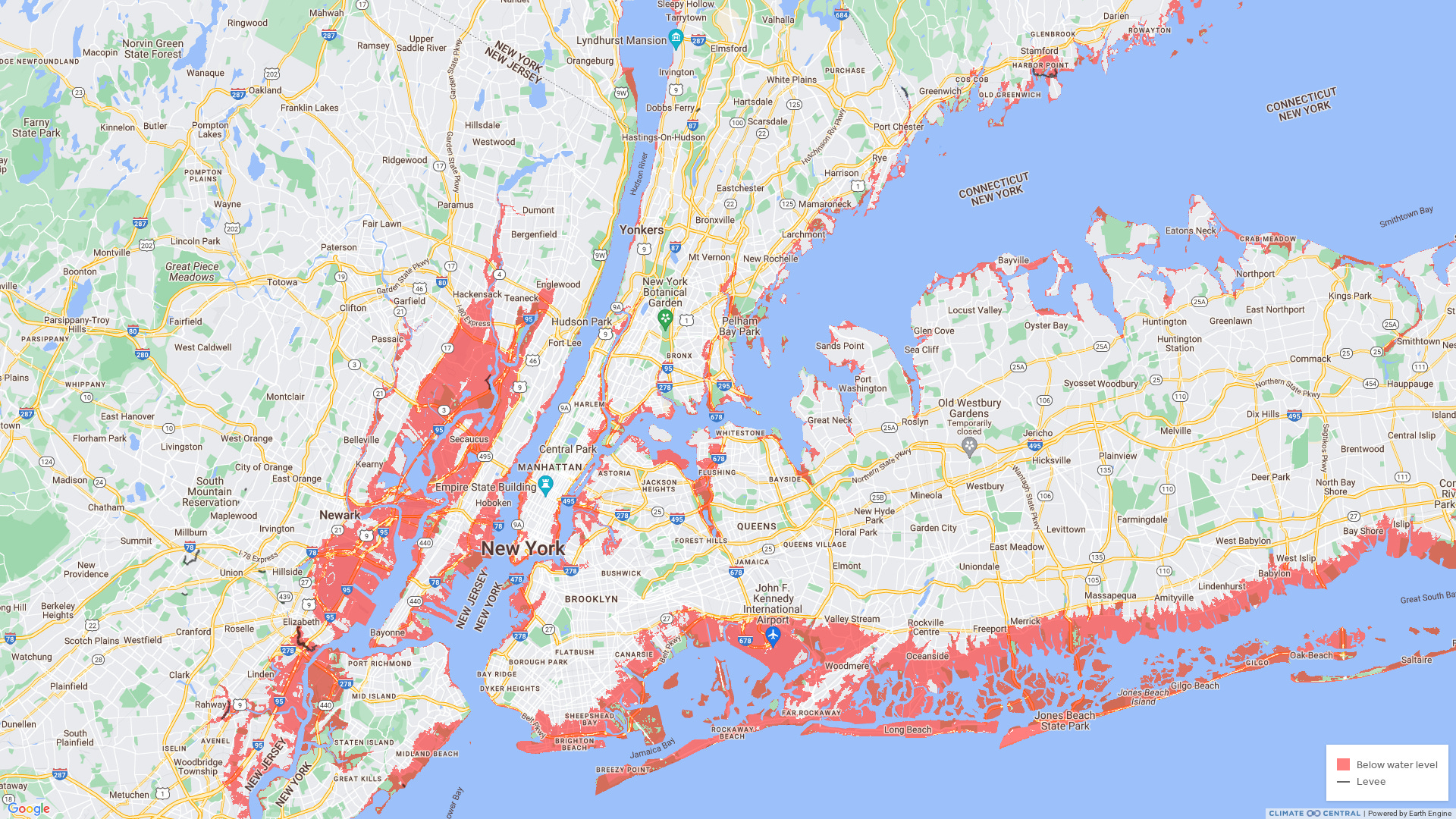
That map comes courtesy of Climate Central, which provides a number of climate projection tools. Cities from Savannah to Charleston look about the same. Lots of red. Lots of businesses underwater. Lots of people either displaced or trudging to work in rubber boots every day.
Cool, huh?
Some experts say there’s no such thing as the doomsday glacier and that none of us will truly have to contend with rising sea levels in our lifetimes.
I think they lack imagination.
People still don’t get it:
The world has failed to keep global temperatures from rising 1.5C degrees above preindustrial averages. For the last ten years, leaders made all kinds of promises about cutting emissions before we crossed the threshold. Climate scientists warned that if we didn’t stick to our goals, it would trigger tipping points and feedback loops that would make the chaos irreversible.
Well, we did it:
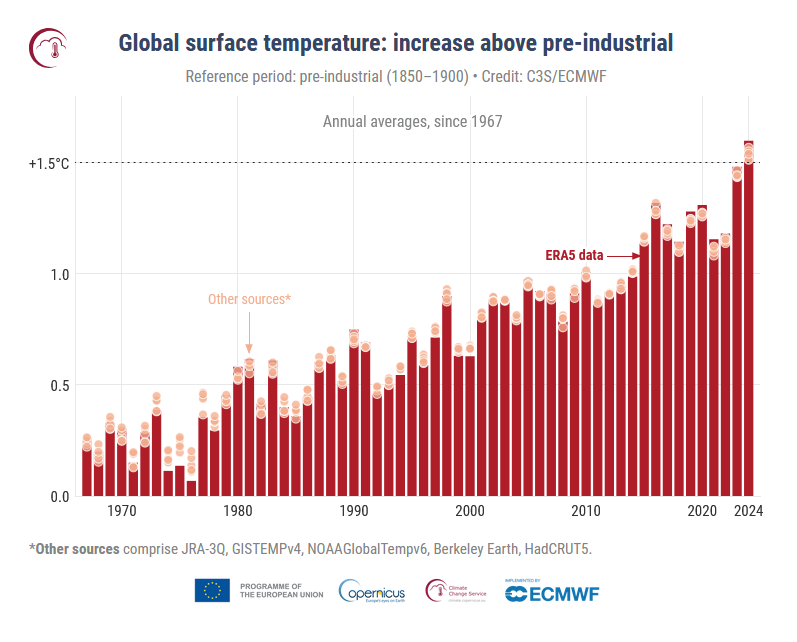
Toxic optimists are still insisting we wait another decade before calling the Paris Agreement a failure. But as one climate scientist wrote recently, "looking back in 10 years... to see what the trend was in the mid-2020s is less useful than developing an understanding of what is happening in real time." So what’s happening now is we’re blazing past 1.5C, and nobody in charge seems to care. We’re even starting to break above 2.0C degrees for brief periods:
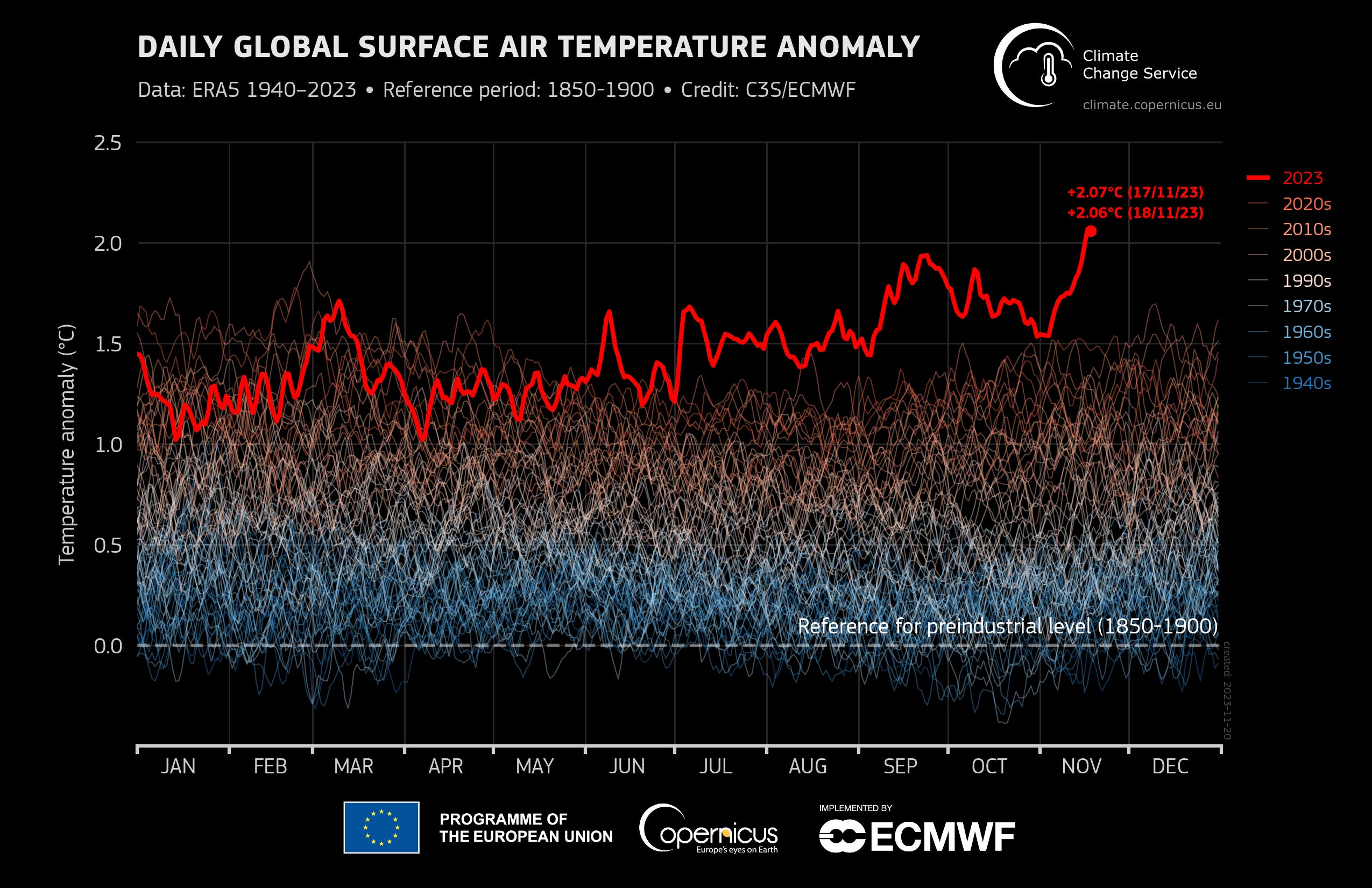
By every practical metric, we’ve lost 1.5C. As Berkeley Earth scientist Zeke Hausfather declared, “The goal to avoid exceeding 1.5C is deader than a doornail. It’s almost impossible to avoid at this point because we’ve just waited too long to act…” And by the way, how do emissions look now?
Here’s another chart:
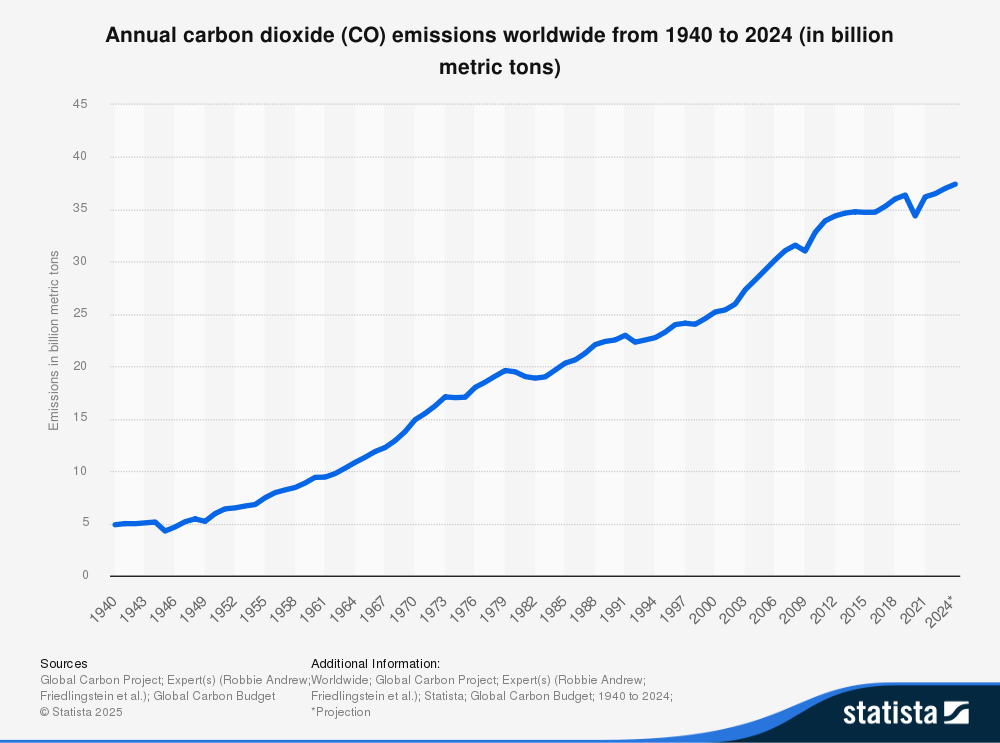
We’re supposed to hit peak emissions this year, or next year, or sometime this decade. But that peak keeps getting pushed back as the tech elite keep coming up with new ways to burn energy. As Bill McKibben recently wrote, the CO2 monitoring station at Mauna Lona recently “recorded the biggest single-year growth in CO2 in its 66-year history, rising 3.58 parts per million.”
So at a time when the world should be slamming the breaks on energy, everyone is slamming the accelerator. You can’t exactly say we’re close to peak emissions when we’re seeing them grow faster than ever.
At this point, burning forests are now adding significantly to those emissions. In 2023 alone, fires choked 640 million metric tons of carbon into the atmosphere. According to a report by NASA, “That’s comparable in magnitude to the annual fossil fuel emissions of a large industrialized nation.” Countries like Iran and Saudi Arabia emit roughly 800 million metric tons per year. Germany, Canada, and South Korea each emit slightly less than 600 million tons.
So, it checks out.
Now, the relentless demands of AI research and development are pushing power companies to keep coal plants alive while booting up nuclear reactors. According to Bloomberg, “electricity consumption at US data centers alone is poised to triple from 2022 levels, to as much as 390 terawatt hours by the end of the decade.” The head of OpenAI, Sam Altman, has even admitted they’re going to need “way more energy…” Dominion predicts they’ll have to double the amount of electricity they can generate within the next decade. They’re not just investing in wind and solar. It won’t keep up with the demand. They’re having to look at coal and natural gas. Utility companies across the country are following the trend. Between robots, semiconductors, cryptocurrencies, electric vehicles, and batteries, these new technologies are driving a resurgence in fossil fuel reliance. You can count on the Trump administration removing every obstacle in their way.
In fact, Trump just recently announced $500 billion in funding for Stargate, a massive data center project devoted to AI research.
They’ve already built ten centers.
If you want to see what the world’s energy consumption looked like before all of this obsession with AI started, take a look:
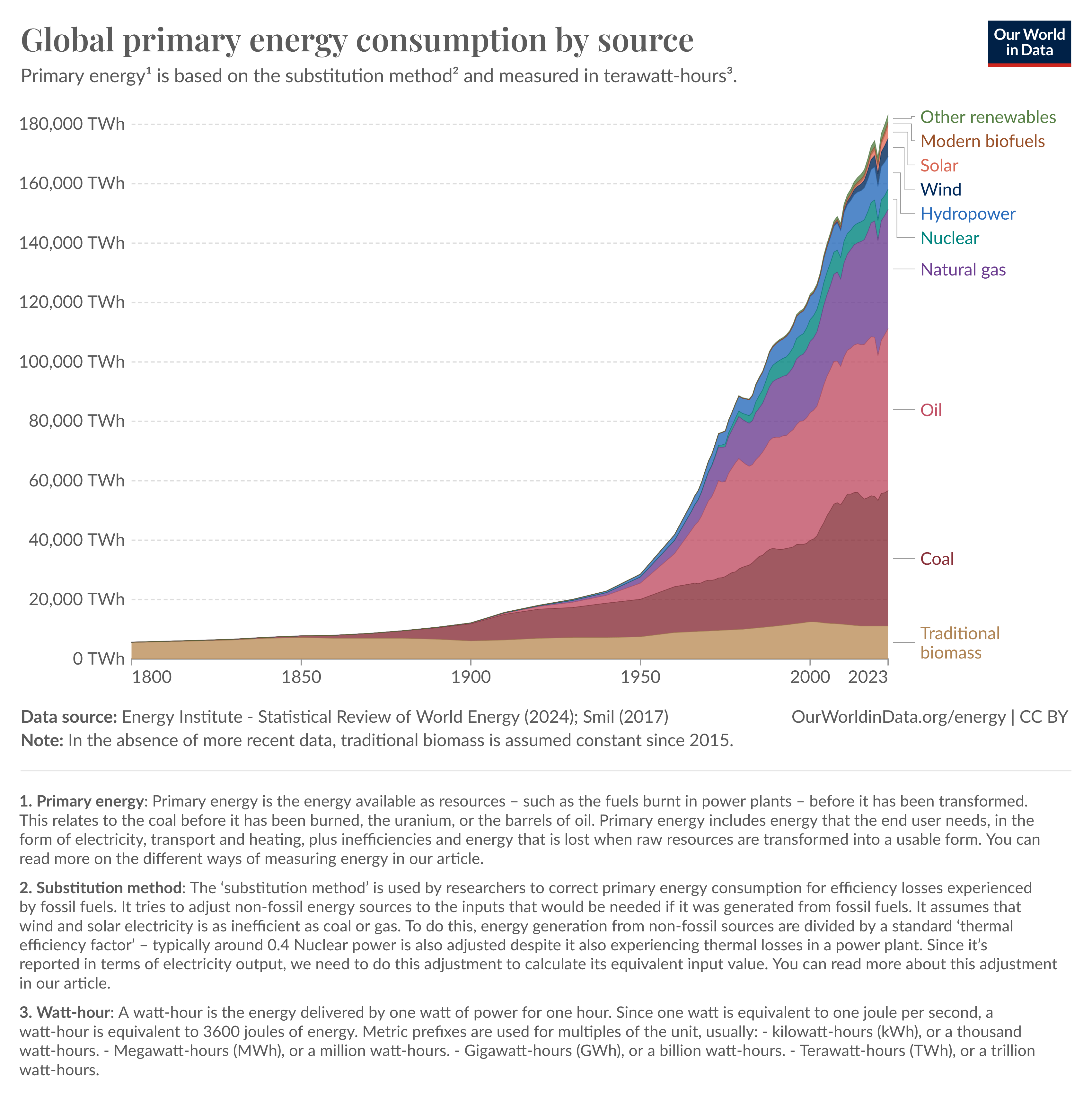
On top of taking credit for massive AI projects already underway, Trump also signed an executive order halting offshore wind leases. His recent barrage of orders, including the order “Unleashing American Energy” seeks to completely undo any progress the U.S. made on solar and wind.
We can get bogged down in the legalities and technicalities of what he can actually do, but all of this makes one thing clear:
If we were ever going to quit coal and gas, that ship has sunk now for the rest of this decade, dubbed “the crucial years” by climate hopefuls like McKibben. Trump and his robot-loving tech bros are going to burn every last bundle of coal they can get their hands on, while also building solar and wind wherever they can, and they’ll probably build more nuclear reactors, too.
How much over 1.5C will we go?
Glad you asked.
A study in Nature Communications estimates that carbon emissions could lead to 7-14C of warming, compared to the 2-4C degrees we’ve been warned about. As the authors explain, "CO2 concentration is likely to have a stronger impact on temperature than we are currently taking into account." Climate scientists have already told us that 2-3C degrees would essentially end industrialized civilization as we know it, and anything more than that is flirting with extinction.
Last year (2024) turned out to be the second worst year on record for tornadoes, and it might still beat out 2004 to become #1. As you can see from the chart below, an average tornado year is now worse than the worst years of the 1980s and 1990s. It’s only up from here, I’m afraid:
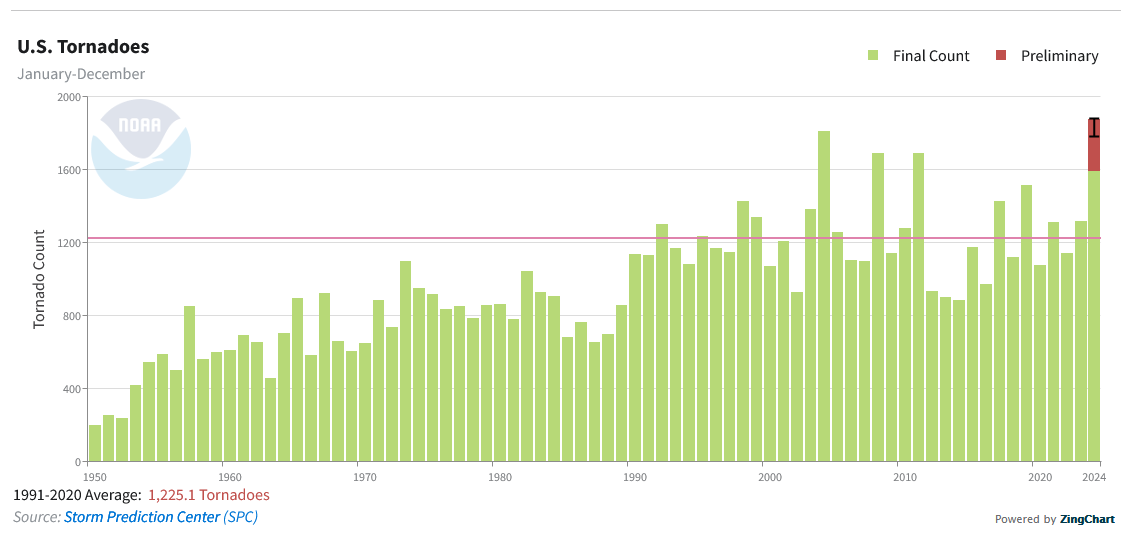
Overall, this last year has cost the U.S. nearly $200 billion in climate disasters, second only to 2023—and they’re not done calculating.
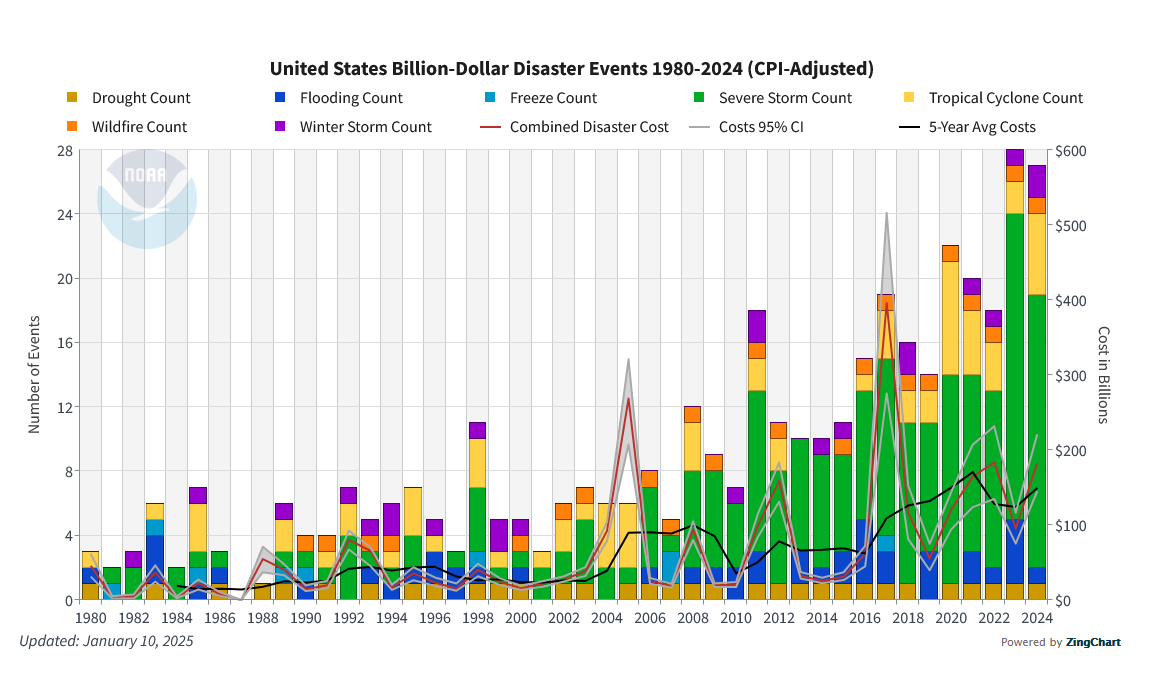
Home insurance has gone up anywhere from 30 to 60 percent just since 2018. Insurance companies are fleeing states like California and Florida. They're even abandoning places like Iowa, once known for stable weather. States are begging them to stay, "offering them more flexibility to raise premiums or drop certain homes from coverage." So, they can collect and collect insurance from you, but once your home is too risky, they'll just cut you loose.
States will let them do it.
According to an analysis in The New York Times, "insurers are losing money, even in states with low hurricane and wildfire danger" in a trend that "could destabilize the broader economy." Yeah, it's hard to have a growth economy without insurance. It's hard to start a business.
It's hard to get a mortgage.
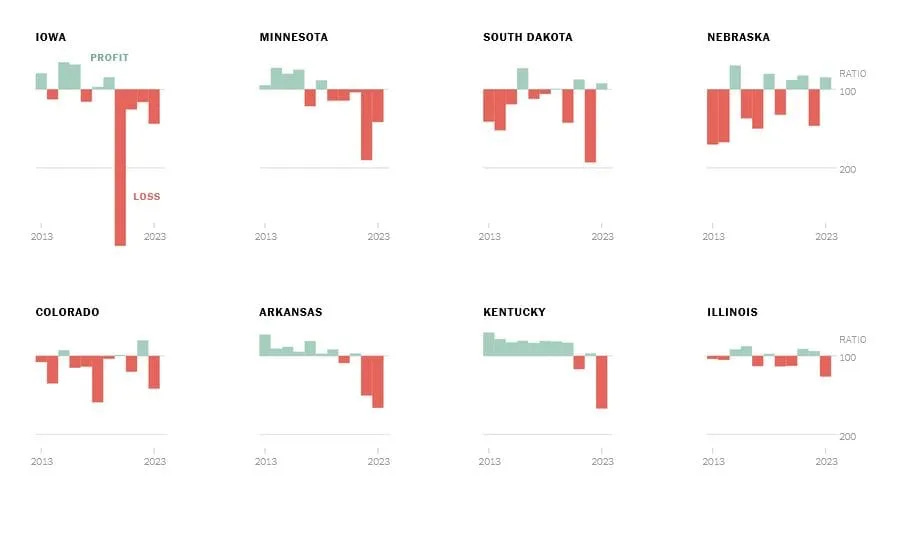
Every summer now, half the world bakes in drought while the other drowns in storms and floods. It's now common to see stories about severe weather threatening our food supply in virtually every news outlet, regardless of the platform or political orientation. Every year, the USDA releases crop data. Look at the production of wheat, a staple crop. In the 1990s, the U.S. was producing somewhere around 2,500 million bushels during a good year. Since 2017, we've produced less than 2,000 million bushels, a clear sustained drop. The years 2021 and 2022 were especially bad, under 1,700 million bushels. Oat production has been hit hard. The U.S. now produces roughly a third as much as we did in the 1990s. We're producing more corn and soybeans, but most of that goes to feed cattle, or it goes into fuels. So when you read about bumper corn and soy crops, understand that this doesn’t mean much except that farmers are choosing to grow what sells.
Recently, Bloomberg published a sobering piece on the devastation that climate change brought to British farmers. Extreme rain "devastated fields for growing grains like wheat and barley, which the UK usually produces to levels that can mostly meet domestic needs." The country will be 8 percent "less self-sufficient for food" this year, meaning more imports and higher prices.
The collapse of our climate will also trigger more pandemics, something Ed Yong wrote about in The Atlantic.
As Yong explains, scientists at Georgetown University created computer simulations that predict 300,000 "first encounters between species that normally don't interact, leading to about 15,000 spillovers wherein viruses enter naive hosts." You can find plenty of articles and studies to back up this prediction. A 2021 study in PNAS found that "the yearly probability of occurrence of extreme epidemics can increase up to threefold in the coming decades," all thanks to climate collapse.
Humans are destroying what's left of the natural world in their relentless pursuit of resources. Animals are increasingly competing with us and each other for space in the areas of the world that remain habitable.
Here's the scary part:
As Yong writes, the computer simulations at Georgetown were optimistic, because they "didn't consider either melting ice or marine mammals... It didn't consider birds, which harbor their own coterie of viruses, including several dangerous influenza strains." On cue, we have a bird flu pandemic knocking on our door. We also have diseases like Ebola and Mpox becoming more widespread, not to mention a resurgence of other diseases.
It’s hard to imagine the future now, but that’s a fairly detailed picture. We can expect rising property insurance to make home ownership a nightmare while probably collapsing the economy at some point before 2040.
We can expect more hurricanes, more floods, more fires more droughts, more tornadoes, more arctic blasts, more heat domes, and all of this is going to turn supply chains inside out. That means neverending inflation. It means drug shortages. It means electronics and appliance shortages. When you can get them, they’re going to be ridiculously expensive. Eventually, shortages will hit stores—kinda like we’re seeing with bird flu and eggs (again). Except eventually it’s going to be coffee. It’s going to be chocolate. It’s going to be beef.
As the history of famines and pandemics have taught us, a lot of people will only expand their capacity for denial in order to cope. They’ll just pretend everything’s fine, until they die. More than anything, you can count on the super rich to continue distracting the public, draining the power grid to build robot girlfriends while we struggle to keep the lights on.
Even the most optimistic visions of the future are going to require us to give up a great deal of what we’ve come to see as “normal.” Some of us are already doing that, and we stand the best chance of making it. That said, every single person, including me, will live a shorter harder life now.
We have to pack the meaning in while we can.
Like I said:
I’m not writing this to scare anyone. If anything, I’m hoping this soothes that restless uncertainty that keeps people awake at night, wondering what’s going to happen next. This all is what happens next. Once you truly see the worst, like I did this last year, I believe it frees you to spend the rest of whatever time you have left doing something that matters—whatever that is to you.
How bad will it get?
That bad.
Enjoy!
Hi Jessica, if you haven’t already, you may want to look at citrus crops collapsing in FL. I know several people in the industry there who think the industry will be gone entirely in 7ish years. On the energy aide, ERCOT in TX gives a breakdown of the current electricity supply. Since the app has updated to include this information it’s been fascinating to watch the mix. Currently wind is 27.7% of all power in the area. Natural gas and coal make up 62%. Now that all the AI has been announced in the state, more investments will need to be made to keep the grid stable, but no one here is talking about it on the news. Nuclear seems like the only option to meet the demand, but the US has only built 2 plants in 30 years. The Permian Basin actually produces more natural gas than they can transport, and tend to just burn it off, which I’m sure plays a larger role in emissions than we tend to realize. As always thanks for writing, your perspective is always appreciated.
There are so many people in the Reddit subs screaming into the void about the collapse of our world.
I feel fairly calm. No matter how bad my life gets, it will always be better than my ancestors. Ancestors who faced the never ending pogroms in Eastern Europe and ancestors who were kidnapped and enslaved in America.
I have already lived longer than Black women in Africa. Some reports say the average lifespan for Black men in the usa is 61. I am 61. I consider any life that I have going forward as bonus life. Life that so many people do not get. Heck, I had sepsis in 2023. At many hospitals or other countries I might have died.
Yes, our future is bleak. I do not understand why people are having children. Their world will more dystopian than ours.
If we think of our lives as a bonus, we can face our present and our future with serenity and calm. Accepting what we cannot change and working to change what we can change.